
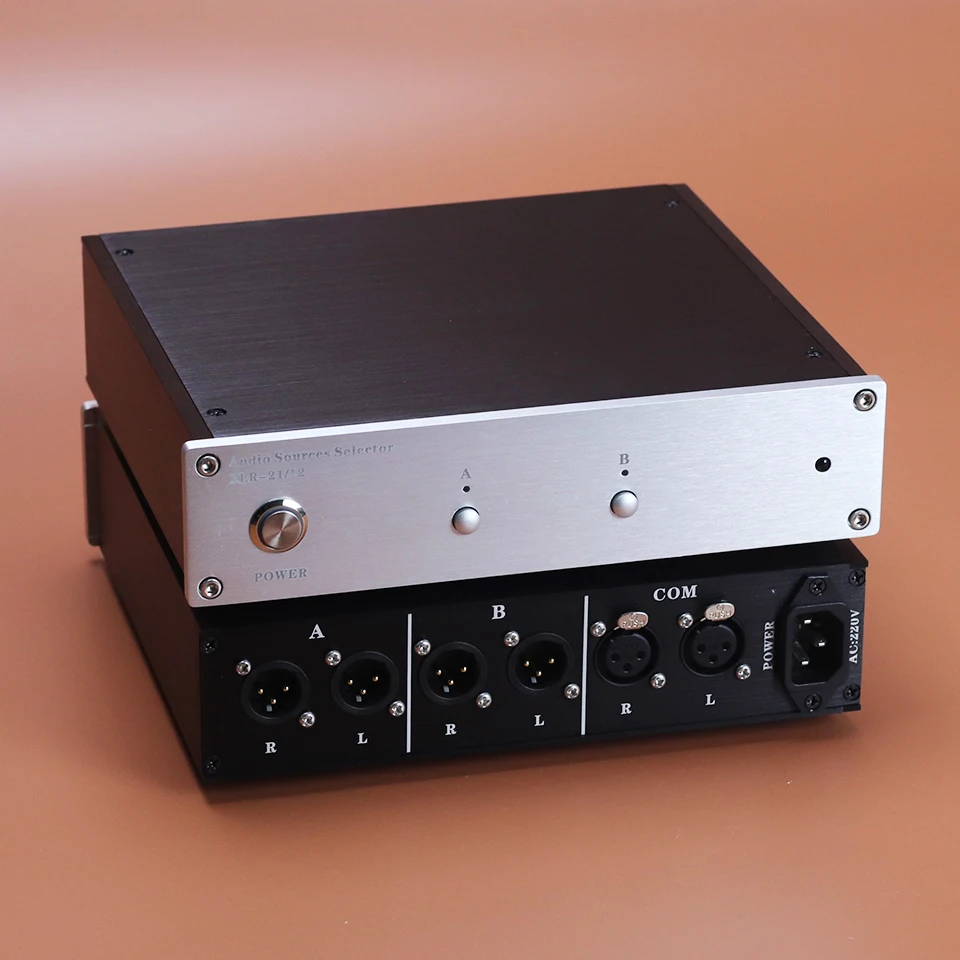
Interruptor de áudio HIFI, seletor de sinal de áudio balanceado XLR de dois canais, alto-falante amplificador de potência, com controle remoto, 2 entradas e 1 saída
You will be redirected to AliExpress to complete your purchase
Specifications
- Brand Name
- ERISU AUDIO
- High-concerned chemical
- None
- Maximum Power Per Channel
- NO POWER
- Origin
- Mainland China
- Channels
- 2 (2.0)
Product Description
Name: XLR interface signal source switcher
Pure aluminum shell + brand signal line + Swiss REAN XLR seat + Taiwan imported selection switch + Japanese imported solder + hand-made by old enthusiasts = audiophile signal switcher.
Name: Two-channel audio signal switcher (lossless switching)
Audio Format: Balanced Analog Signal
Connecting wire: balanced audio cable (XLR signal cable)
Scope of application:
1. Switch between signal sources such as CD players, digital broadcasting, set-top boxes, radios, decoders, etc. and power amplifiers (or active speakers);
2. Switch between the front and rear stages of the power amplifier.
Delivery time: Conventional products are generally available in stock. If the conventional products do not have what you need, you can customize them. The delivery time of customized products is 25~30 days, and a 50% deposit is required for customized products, please consult customer service for details.
Why do you need a switcher: For audiophiles like me, there are many signal sources and power amplifiers at home. Unplugging and plugging is a long-term pain. Sometimes the interest in listening to music after connecting the cables is much reduced or even disappeared. So switchers came into being, and there are similar stuffs on the market, AV switches costing tens of yuan, and the internal materials are terrible! ! Some use cables inside, some use the gear switch of the floor fan, some use plastic shells, or rusty iron boxes. The signal source is a weak signal, which is afraid of interference and loss, so shielding is the primary issue. All metal casings must be used, high-quality shielded wires must be used for signal lines, copper sockets must be used, and reliable switches must be used. In the picture descriptions that follow, you will fully feel that it is exactly what you have been looking for for a long time.
Popularization of basic knowledge: 1. A switcher, as the name implies, is a switch. It cannot mix multiple input signals, nor can it output multiple channels at the same time; the signals can only be rotated in and out. 2. The name of the product that can mix multi-channel signals is called a mixer. We mainly serve audiophiles here. It is impossible for audiophiles to use mixers, so our factory will not mass-produce mixers. 3. The name of the product that enters one channel and simultaneously outputs from multiple channels is called a splitter, which is used for multi-channel playback requirements, electronic frequency division, and power amplifier/speaker sound quality comparison. Our factory has production, please see another link in the store.
5. Things about audio weak signal switching
1. "Cracking" sound, a unique symptom of low-end mechanical rotary switches, poor contact material, and low manufacturing accuracy. Mid-to-high-end precision switches or relays will not have this problem.
2. There is a "pop", this problem has nothing to do with the switcher. It is related to the DC potential difference between the front-end and back-end equipment of the switcher. Whether it is pure DC coupling or capacitive isolation, as long as there is a potential difference, there will be a "pop", and the sound is proportional to the potential difference. Whether it is mechanical switch switching or relay switching, the relay closing time is short and the impact pulse is sharper. Well-designed front and rear equipment, switching noise is inaudible.
3. "Buzzing..." continuous hum, the magnetic flux leakage of the transformer in the audio equipment (all transformers have magnetic flux leakage) radiates and induces the transmission line. The reasons are as follows: poor cable shielding, common ground between audio equipment, open circuit of input line (including when the switcher disconnects the signal connection), the switcher is too close to the transformer of the power amplifier.
4. "Rustle..." continuous bottom noise, called broad-spectrum noise or pink noise. As long as there are audio equipment, the general equipment can be controlled at a level that cannot be heard by the human ear. If the rustling sound increases after connecting to the switcher, it is usually a problem with the cable.
5. Loss: This is a popular term. In the field of audio, it usually appears in content formats, such as lossless compression, lossless format, and lossless U disk; the equipment is a lossless player; enthusiasts who often play audio and listen to music must understand that the so-called lossless is Exaggerated advertising language. The accelerated rise in sales of CD players in recent years illustrates this point. Going back to the switcher is lossless switching, and any parts inserted will be lost. This is a question of balance, if the loss caused by the insertion of parts or machines is minimal, and can be exchanged for other good things. Use a digital bridge to test the inductance, capacitance and resistance data of the switcher in this link at a test frequency of 7.8KHZ (audio range 20HZ--20KHZ that can be heard by the human ear). I'm not ashamed to say "lossless switching". It should be "minimal loss switching", which is similar to a slightly longer wire, and the loss is smaller than any resistor in the power amplifier.
Shipping list:
● Audio Switcher*1
● Power cord*1 (you can choose US plug, EU plug, UK plug, Australian plug, please write down the type of plug you need when ordering)
● Infrared remote control*1 (due to shipping requirements, some countries and regions are shipped without batteries, you need to prepare your own batteries)
A 2 in 1 out 2-1, A 1 in 2 out 1-2
Chassis dimensions (excluding front, rear, and bottom protrusions): 220 * 210 * 62mm, net weight 1.4kg.
8-channel, optional:
A: 2 in, 1 out
B: 1 in, 2 out
Note: The 8-channel delivery time requires 30 days. Please extend the delivery time after placing the order.
C 3 in 1 out
Chassis dimensions (excluding front, rear, and bottom protrusions): 170 * 150 * 78mm, net weight 1.4kg.
Pros & Cons
Pros
- Switching lossless sem perda de sinal para áudio balanceado XLR
- Controle remoto conveniente para 2 canais
- Construção premium com alumínio e componentes importados
- Compatível com amplificadores de potência e alto-falantes HIFI
Cons
- Sem potência por canal, apenas seletor de sinal
- Limitado a 2 entradas/1 saída
- Requer cabos XLR específicos
- Preço pode ser alto para handmade audiophile
Common Questions
Qual o material do interruptor de áudio HIFI seletor XLR ERISU AUDIO?
Carcassagem em alumínio puro, com fios de sinal de marca, conector REAN XLR suíço e solda japonesa importada.
Quantas entradas e saídas no seletor balanceado XLR de 2 canais?
2 entradas e 1 saída, para 2 canais (2.0), com controle remoto para amplificadores de potência e alto-falantes.
É compatível com fontes de sinal lossless no switcher áudio HIFI?
Sim, switching lossless para interfaces XLR, handmade por entusiastas audiophiles, sem potência máxima por canal.
Como usar o seletor de sinal XLR com controle remoto?
Conecte cabos XLR nas entradas, selecione via remoto ou switch Taiwan importado, para alternar fontes de áudio balanceado.
Envio do interruptor áudio 2 canais da China Continental?
Frete padrão 10-30 dias, origem Mainland China, sem químicos preocupantes, ideal para setups HIFI profissionais.
Product information last updated on December 3, 2025