
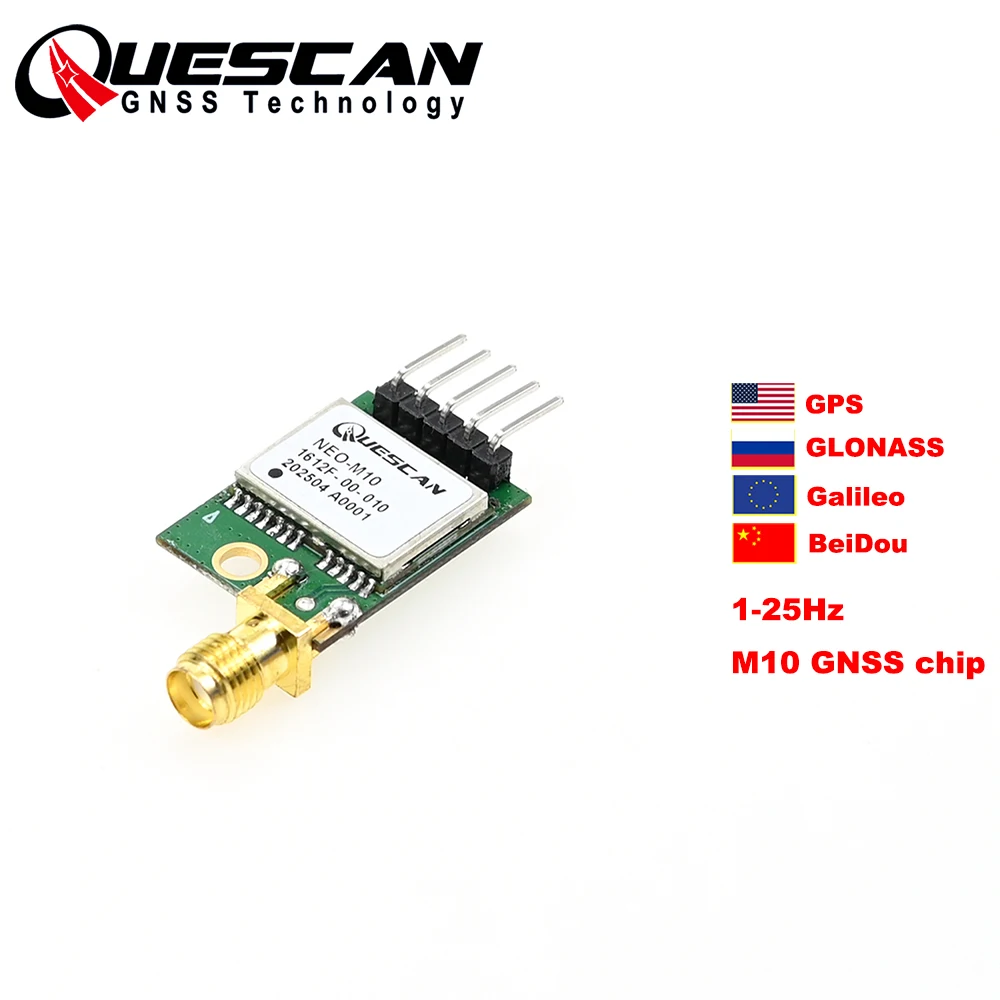
QUESCAN UBX-M10050-KB M10 GPS GNSS Module with Active Antenna ESP32 Arduino NMEA GPS Galileo GLONASS BeiDou Receiver PPS 1PPS
You will be redirected to AliExpress to complete your purchase
Specifications
- Brand Name
- QUESCAN
- High-concerned chemical
- None
- Origin
- Mainland China
- Model Name
- 1612Z1
- GPS type
- Receiver & Antenna
- GNSS
- GPS Galileo BeiDou GLONASS QZSS SBAS
- Chipset
- UBX M10
- Nav update rate
- Max. 25Hz
- Speed Accuracy
- 0.05m/s
- Tracking Sensitivity
- -169dBm
- TTFF
- 23 S
- Hot Start
- 1 S
- Time Precision
- 30ns
- Baudrate
- 4800-921600bps.Default 38400
- Protocol
- NMEA 0183/UBX
- NMEA sentence
- RMC GGA GSA GSV GLL VTG
- Interface
- UART TTL
- Flash memory
- Support
- Power
- DC 3.3V-5.0V
- Connector type
- 2.54 single row male 5P
Product Description
Overview
M10-1612 module features the UBX M10 standard precision GNSS platform and provides exceptional sensitivity and acquisition time for all L1 GNSS signals.M10-1612 supports a maximum positioning update rate of 25Hz (need to be configured in high-performance mode).M10-1612 is a highly cost-effective GNSS L1 solution.
The M10 platform supports concurrent reception of four GNSS (GPS, GLONASS, Galileo, and BeiDou) with QZSS SBAS enable. The high number of visible satellites enables the receiver to select the best signals. This maximizes the position availability, in particular under challenging conditions such as in deep urban canyons.
UBX Super-S (Super-Signal) technology offers great RF sensitivity and can improve the dynamic position accuracy with small antennas or in non-line-of-sight scenarios.
M10-1612 module supports NMEA and UBX protocol input and output. It is recommended to use UBX-NAV-PVT statement under UBX protocol, which is widely used in various controllers.
M10-1612 module has built-in Flash memory and supports customization of various configurations of the module.
Specification
Pin Definition
Detail
Supported GNSS constellations
M10-1612 is a concurrent GNSS receiver that can receive and track multiple GNSS systems. The single RF front-end architecture enables concurrent reception of multiple GNSS constellations. The receiver can be configured for a subset of GNSS constellations to achieve lower power consumption.
The factory configuration on M10-1612 is concurrent reception of GPS,Galileo,GLONASS and BeiDou B1C with QZSS and SBAS enabled.
The following GNSS and their signals are supported:
The following augmentation systems are supported:
Dynamic platform
The dynamic platform model can be configured through the CFG-NAVSPG-DYNMODEL
configuration item. For the supported dynamic platform models and their details please refer to the table below. The default dynamic model is Portable.
Dynamic platform models and details:
Factory Settings
•GPS+Galileo+GLONASS+BeiDou+QZSS+SBAS
•38400 baud, 8 bits, no parity bit, 1 stop bit.
•1Hz navigation update rate.
•1PPS time pulse
•NMEA version 4.11.
•Input messages: NMEA and UBX.
•Output messages: NMEA GGA, GLL, GSA, GSV, RMC, VTG and TXT.
Configuration software
U-center
Performance
Pros & Cons
Pros
- Uses the UBX M10 high-precision GNSS chipset for reliable, accurate positioning
- Supports multiple global GNSS signals for improved coverage in urban or remote areas
- Fast acquisition time with 1-second hot start and 23-second cold start TTFF
- High tracking sensitivity of -169dBm, with a maximum positioning update rate of 25Hz in high-performance mode
Cons
- Requires configuration to enable the 25Hz maximum positioning update rate, which may be complex for beginner users
- Only features a UART TTL interface, which may not be compatible with all microcontroller or development board setups
- No included mounting hardware or installation instructions for easy integration into projects
- Ships from Mainland China, leading to potential longer delivery times for international customers
Common Questions
What GNSS signals does this GPS module support?
It supports GPS, Galileo, BeiDou, GLONASS, QZSS, and SBAS L1 GNSS signals.
What is the default baud rate and communication protocol for this GPS module?
The default baud rate is 38400bps, and it uses NMEA 0183/UBX communication protocols.
What power input does this GPS module require?
It operates on a DC 3.3V to 5.0V power supply.
How long does it take for this module to acquire a satellite lock?
It has a TTFF (Time to First Fix) of 23 seconds for cold start, and 1 second for hot start.
Where is this GPS module shipped from, and what connector type does it use?
This product ships from Mainland China, and features a 2.54 single row male 5P connector interface.
Product information last updated on November 18, 2025