
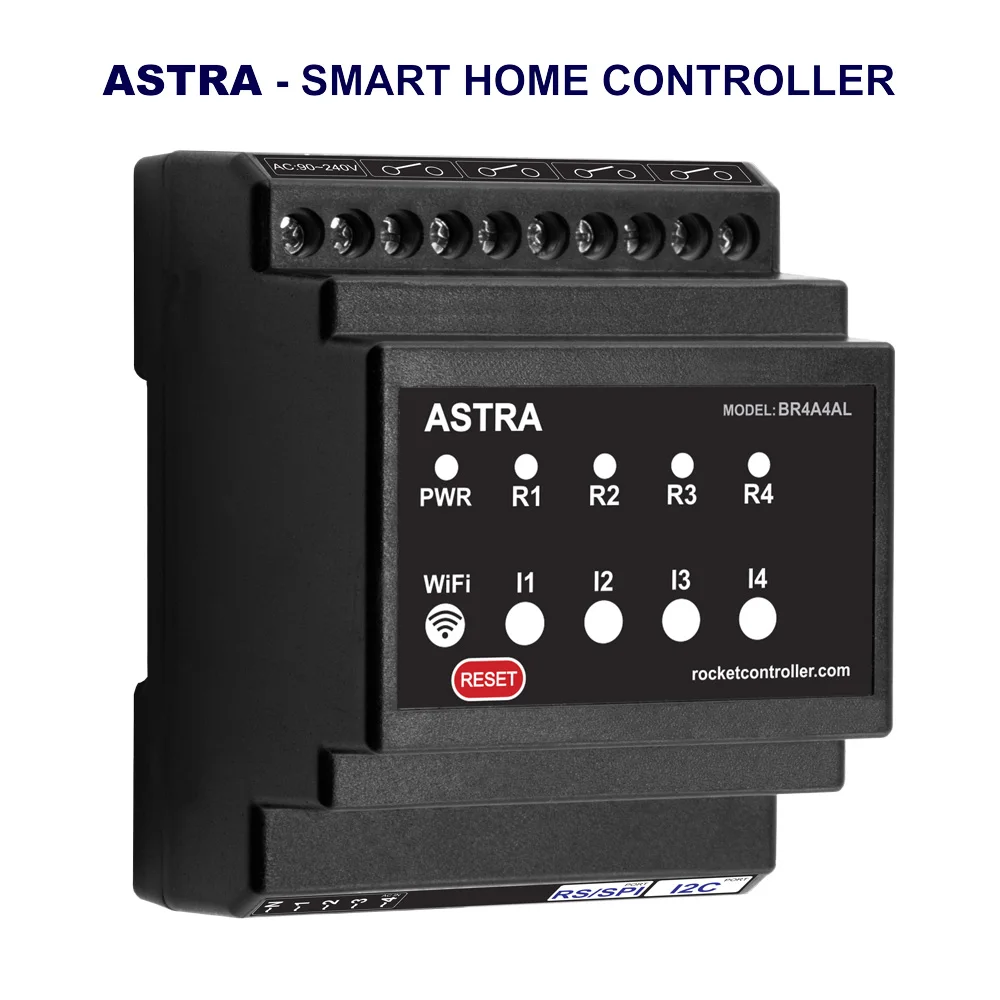
Basic Smart Home controller. WiFi, Bluetooth. Input/Output. TASMOTA firmware. MQTT protocol. Compatible Home Assistant. ESP32
You will be redirected to AliExpress to complete your purchase
Specifications
- Brand Name
- RobotDyn
- Origin
- Mainland China
- High-concerned chemical
- None
- Model Number
- AST-B
- WiFi
- 2.4 GHz
- Bluetooth
- BLE 5.0
- MCU
- ESP32
Product Description
All home functions are integrated into one automation system – ASTRA!
Features an impressive array of functions for individual solutions. And cost-effective, space-saving implementation, as well as comprehensive WiFi and expansion options, pay off when automating a home.
Opens up a wide range of control options for building functions, making it the perfect choice for fast, easy, and space-saving implementation of individual home automation projects. Provides the right solution for the convenient control of your heating, air-conditioning, lighting, irrigation, access control, garage door, presence detection, and for saunas and pools.
Especially handy is the controller's ability to connect to a smart home server as well as convenient control via smartphone, tablet, and PC through WiFi.
Garage
Garage Door: opening & closing. Automatization, RF KeyFob switch, and voice control.
CO2 gas sensor, fire sensors. Alarm. Notification. Ventilation.
Laundry & boiler room
Power control and energy efficiency and monitoring. Timetable ON/OFF.
Smart water heater, temperature control, and temperature limitation.
Leak detection. Alarm. Notification. Automatization.
Tap water valves, and water pump control.
Propane/butane gas detection. Alarm. Notification. Ventilation.
Security
Smart locks.
Camera and intercome.
RFID and code access.
Motion control.
Living room
Light control. Dimming. Automatization voice control.
Light switch operation, script, and automatization.
Shutters and Blinds. Sunlight protection. Timetable, automatization, voice control.
Smart plugs and appliances.
Termostate, heating & cooling. Air temperature. Timetable, automatization, voice control, ventilation.
Garden & waterpool
Garden lights. Timetable, automatization, motion control.
Motion sensor. Security.
Garden irrigation. Soil sensor. Water pump and valves control.
Waterpool. Water level control. Water pump and valve control. Water temperature control. Water quality control.
Highlights of the new ASTRA Smart Home controller
All units come with a WiFi and Bluetooth interface;
Basic units with Outputs: Relays 16A, Solid-State relays 16A, Mosfets 30A;
Versions for Inputs: isolated AC, isolated DC (dry contact), direct GPIO (3.3V);
Several versions for different supply power DC 7~36V, AC 90~240V;
Integrated web server with web interface and MQTT protocol;
Extended temperature range -20 to 55°C, without condensation.
Powerful with ESP32, 2.4 GHz Wi-Fi and Bluetooth LE 5.0, ASTRA can perform as a complete standalone system or as a slave device to a main server, reducing communication stack overhead on the main application processor. ESP32 can interface with other systems to provide Wi-Fi and Bluetooth functionality through its UART, I2C, SPI, SDIO interfaces.
TASMOTA - OPEN SOURCE FIRMWARE
Total local control of equipment and simple interface. TAMSOTA device firmware preinstalled and configured to ASTRA controller. Easy to configure for any customs projects. Easy to update and upgrade. Multilanguage interface.
Control using MQTT, Web UI, HTTP or serial.
Automate using timers, rules or scripts.
Integration with home automation solutions.
Incredibly expandable and flexible.
TASMOTA – Open source firmware for ASTRA
Easily integrates with many home automation solutions reporting status and sensor data and allowing complete control:
Tasmota, Alexa, AWS IoT, Domoticz, Home Assistant, Homebridge, HomeSeer, IP Symcon, KNX, NodeRed, nymea, OctoPrint, openHAB, Otto, IOBroker, Mozilla WebThings Adapter, SmartThings
Total local control with quick setup and updates.
Basic modules | R4A4AL | R4D4DL | R4G4DL | T4A4AL | M4D4DL |
4 Relays, 4 AC In, PWR AC, LED | 4 Relays, 4 DC In, PWR DC, LED | 4 Relays, 8 GPIO, PWR DC, LED | 4 SSR, 4 AC In, PWR AC, LED | 4 MOSFET, 4 DC In, PWR DC, LED | |
Supply voltage | |||||
Rated value (AC) | 90~240V (VAC 50/110Hz) | 90~240V (VAC 50/110Hz) | |||
Rated value (DC) | 7~36V (VDC) | 7~36V (VDC) | 7~36V (VDC) | ||
Digital outputs | 4 Relays 16A, external fusing necessary | 4 Relays 16A, external fusing necessary | 4 Relays 16A, external fusing necessary. 8 Input/Output (GPIO) 3.3V logic level | TRIAC (SSR) 16A, external fusing necessary | Transistor MOSFET 15A, external fusing necessary |
Relays switching capacity of contacts | VAC 240V, VDC 30V | VAC 240V, VDC 30V | VAC 240V, VDC 30V | ||
with inductive load, max. (normal use=70%max.) | 10 A | 10 A | 10 A | ||
with resistive load, max. (normal use=70%max.) | 16 A | 16 A | 16 A | ||
Digital inputs | 4 AC Isolated | 4 DC Isolated, dry contact | 8 Input/Output (GPIO) 3.3V logic level | 4 AC Isolated | 4 DC Isolated, dry contact |
Analog Inputs | no | no | no | no | no |
Indicate | |||||
Output | 4 LED (blue) | 4 LED (blue) | 4 LED (blue) | 4 LED (blue) | 4 LED (blue) |
Input | 4 LED (green) | 4 LED (green) | – | 4 LED (green) | 4 LED (green) |
WiFi status | LED (blue) | LED (blue) | LED (blue) | LED (blue) | LED (blue) |
Power IN | LED (red) | LED (red) | LED (red) | LED (red) | LED (red) |
Sound | Buzzer | Buzzer | Buzzer | Buzzer | Buzzer |
Mounting | DIN 35mm | DIN 35mm | DIN 35mm | DIN 35mm | DIN 35mm |
Basic modules | R4A4AL | R4D4DL | R4G4DL | T4A4AL | M4D4DL |
4 Relays, 4 AC In, PWR AC, LED | 4 Relays, 4 DC In, PWR DC, LED | 4 Relays, 8 GPIO, PWR DC, LED | 4 SSR, 4 AC In, PWR AC, LED | 4 MOSFET, 4 DC In, PWR DC, LED | |
Firmware | TASMOTA (version link), configuration (link) (TASMOTA weblink) | ||||
Webserver | integrated web server with web interface | ||||
MQTT | MQTTv2 | ||||
Interface | Serial UART, SPI, I2C (3.3V logic level) | ||||
WiFi | 802.11 b/g/n , 802.11n (2.4Ghz), up to 150Mbps | ||||
Bluetooth | Bluetooth V4.2 BR/EDR and BLE specification | ||||
MCU | Microcontroller Espressif ESP32-D0WDQ6, core Xtensa dual core 32-bit LX6 microprocessor, up to 600MIPS, operation voltage 3.3V | ||||
Flash memory | Capacity 32Mbit (4Mbyte), NOR FLASH, SPI, operation voltage 3.3V | ||||
Basic modules | R4A4AL | R4D4DL | R4G4DL | T4A4AL | M4D4DL |
4 Relays, 4 AC In, PWR AC, LED | 4 Relays, 4 DC In, PWR DC, LED | 4 Relays, 8 GPIO, PWR DC, LED | 4 SSR, 4 AC In, PWR AC, LED | 4 MOSFET, 4 DC In, PWR DC, LED | |
Dimensions | |||||
Width | 90mm | 90mm | 90mm | 90mm | 90mm |
Height | 72mm | 72mm | 72mm | 72mm | 72mm |
Depth | 65mm | 65mm | 65mm | 65mm | 65mm |
Pakage dimensions | 80mm*100mm*90mm | ||||
Weight | |||||
Netto (w/o addtiional modules) | 0.24kg/0.29kg with external antenna | 0.24kg/0.29kg with external antenna | 0.24kg/0.29kg with external antenna | ||
Brutto | 0.29kg/0.32kg with external antenna | 0.29kg/0.32kg with external antenna | 0.29kg/0.32kg with external antenna | ||
Basic modules | R4A4AL | R4D4DL | R4G4DL | T4A4AL | M4D4DL |
4 Relays, 4 AC In, PWR AC, LED | 4 Relays, 4 DC In, PWR DC, LED | 4 Relays, 8 GPIO, PWR DC, LED | 4 SSR, 4 AC In, PWR AC, LED | 4 MOSFET, 4 DC In, PWR DC, LED | |
Degree of protection | IP20 | IP20 | IP20 | IP20 | IP20 |
Ambient conditions | |||||
Ambient temperature during operation | |||||
min. | -20 °C; No condensation | -20 °C; No condensation | -20 °C; No condensation | -20 °C; No condensation | -20 °C; No condensation |
max. | 55 °C | 55 °C | 55 °C | 55 °C | 55 °C |
Ambient temperature during storage/transportation | |||||
min. | -40 °C | -40 °C | -40 °C | -40 °C | -40 °C |
max. | 70 °C | 70 °C | 70 °C | 70 °C | 70 °C |
Firmware configuration.
Basic modules | R4A4AL | R4D4DL | R4G4DL | T4A4AL | M4D4DL |
4 Relays, 4 AC In, PWR AC, LED | 4 Relays, 4 DC In, PWR DC, LED | 4 Relays, 8 GPIO, PWR DC, LED | 4 SSR, 4 AC In, PWR AC, LED | 4 MOSFET, 4 DC In, PWR DC, LED | |
GPIO34 | Input-1 | Input-1 | GPIO34 | Input-1 | Input-1 |
GPIO35 | Input-2 | Input-2 | GPIO35 | Input-2 | Input-2 |
GPIO36 | Input-3 | Input-3 | GPIO36 | Input-3 | Input-3 |
GPIO39 | Input-4 | Input-4 | GPIO39 | Input-4 | Input-4 |
GPIO25 | Relay-1 | Relay-1 | Relay-1 | Relay-1 | Relay-1 |
GPIO26 | Relay-2 | Relay-2 | Relay-2 | Relay-2 | Relay-2 |
GPIO33 | Relay-3 | Relay-3 | Relay-3 | Relay-3 | Relay-3 |
GPIO32 | Relay-4 | Relay-4 | Relay-4 | Relay-4 | Relay-4 |
GPIO4 | LED WiFi | LED WiFi | LED WiFi | LED WiFi | LED WiFi |
GPIO12 | Sound Buzzer | Sound Buzzer | Sound Buzzer | Sound Buzzer | Sound Buzzer |
GPIO27 | RF433/315 socket | RF433/315 socket | GPIO27 / RF433 | RF433/315 socket | RF433/315 socket |
GPIO14 | – | – | IO14 | – | – |
GPIO15 | – | – | IO15 | – | – |
RXD0 | Serial1 RXD | Serial1 RXD | Serial1 RXD | Serial1 RXD | Serial1 RXD |
TXD0 | Serial1 TXD | Serial1 TXD | Serial1 TXD | Serial1 TXD | Serial1 TXD |
GPIO16 | Serial2 RXD | Serial2 RXD | Serial2 RXD | Serial2 RXD | Serial2 RXD |
GPIO17 | Serial2 TXD | Serial2 TXD | Serial2 TXD | Serial2 TXD | Serial2 TXD |
GPIO13 | Serial2 CS | Serial2 CS | GPIO13/Serial2 CS | Serial2 CS | Serial2 CS |
GPIO5 | SPI CS0 | SPI CS0 | SPI CS0 | SPI CS0 | SPI CS0 |
GPIO18 | SPI CLK | SPI CLK | SPI CLK | SPI CLK | SPI CLK |
GPIO19 | SPI MISO | SPI MISO | SPI MISO | SPI MISO | SPI MISO |
GPIO23 | SPI MOSI | SPI MOSI | SPI MOSI | SPI MOSI | SPI MOSI |
GPIO21 | I2C SDA | I2C SDA | I2C SDA | I2C SDA | I2C SDA |
GPIO22 | I2C SCL | I2C SCL | I2C SCL | I2C SCL | I2C SCL |
GPIO2 | I2C INT | I2C INT | I2C INT | I2C INT | I2C INT |
GPIO0 | PROG | PROG | PROG | PROG | PROG |
EN | RESET | RESET | RESET | RESET | RESET |
Basic modules | R4A4AL | R4D4DL | R4G4DL | T4A4AL | M4D4DL |
4 Relays, 4 AC In, PWR AC, LED | 4 Relays, 4 DC In, PWR DC, LED | 4 Relays, 8 GPIO, PWR DC, LED | 4 SSR, 4 AC In, PWR AC, LED | 4 MOSFET, 4 DC In, PWR DC, LED | |
I2C | |||||
1 | – | – | – | – | – |
2 | GND | GND | GND | GND | GND |
3 | I2C SDA | I2C SDA | I2C SDA | I2C SDA | I2C SDA |
4 | I2C SCL | I2C SCL | I2C SCL | I2C SCL | I2C SCL |
5 | I2C INT | I2C INT | I2C INT | I2C INT | I2C INT |
6 | – | – | – | – | – |
RS/SPI | |||||
RS mode | |||||
1 | – | – | – | – | – |
2 | GND | GND | GND | GND | GND |
3 | Serial2 RXD | Serial2 RXD | Serial2 RXD | Serial2 RXD | Serial2 RXD |
4 | Serial2 TXD | Serial2 TXD | Serial2 TXD | Serial2 TXD | Serial2 TXD |
5 | Serial2 CS | Serial2 CS | Serial2 CS | Serial2 CS | Serial2 CS |
6 | – | – | – | – | – |
SPI mode | |||||
1 | 3.3V | 3.3V | 3.3V | 3.3V | 3.3V |
2 | GND | GND | GND | GND | GND |
3 | SPI MOSI | SPI MOSI | SPI MOSI | SPI MOSI | SPI MOSI |
4 | SPI MISO | SPI MISO | SPI MISO | SPI MISO | SPI MISO |
5 | SPI CLK | SPI CLK | SPI CLK | SPI CLK | SPI CLK |
6 | SPI CS0 | SPI CS0 | SPI CS0 | SPI CS0 | SPI CS0 |
Pros & Cons
Pros
- Supports both 2.4 GHz WiFi and BLE 5.0 Bluetooth for wide smart home device compatibility
- Pre-loaded with TASMOTA firmware for flexible, customizable home automation setups
- Compatible with Home Assistant, a popular open-source smart home platform
- Compact, space-saving design for cost-effective home automation integration
Cons
- Only supports 2.4 GHz WiFi networks, so it cannot connect to 5 GHz WiFi bands
- No included setup instructions or mounting hardware, requiring buyers to source additional parts for installation
- The product description is cut off, limiting available details on supported specific devices
- No built-in user interface, so all configuration must be done via a smart home platform or command line
Common Questions
Which smart home platforms is this controller compatible with?
This controller is compatible with Home Assistant, and uses the MQTT protocol for seamless connectivity between devices.
What wireless connectivity options does this smart controller have?
It supports 2.4 GHz WiFi and BLE 5.0 Bluetooth for broad compatibility with smart home devices.
What firmware does this smart controller run?
This controller comes pre-installed with TASMOTA firmware, allowing for flexible custom automation configurations.
What main control chip does this smart home controller use?
This controller uses an ESP32 MCU for reliable performance and expanded connectivity options.
What can this smart home controller be used for?
It integrates all home functions into a single automation system, supporting custom individual solutions for home automation.
Product information last updated on April 22, 2026