
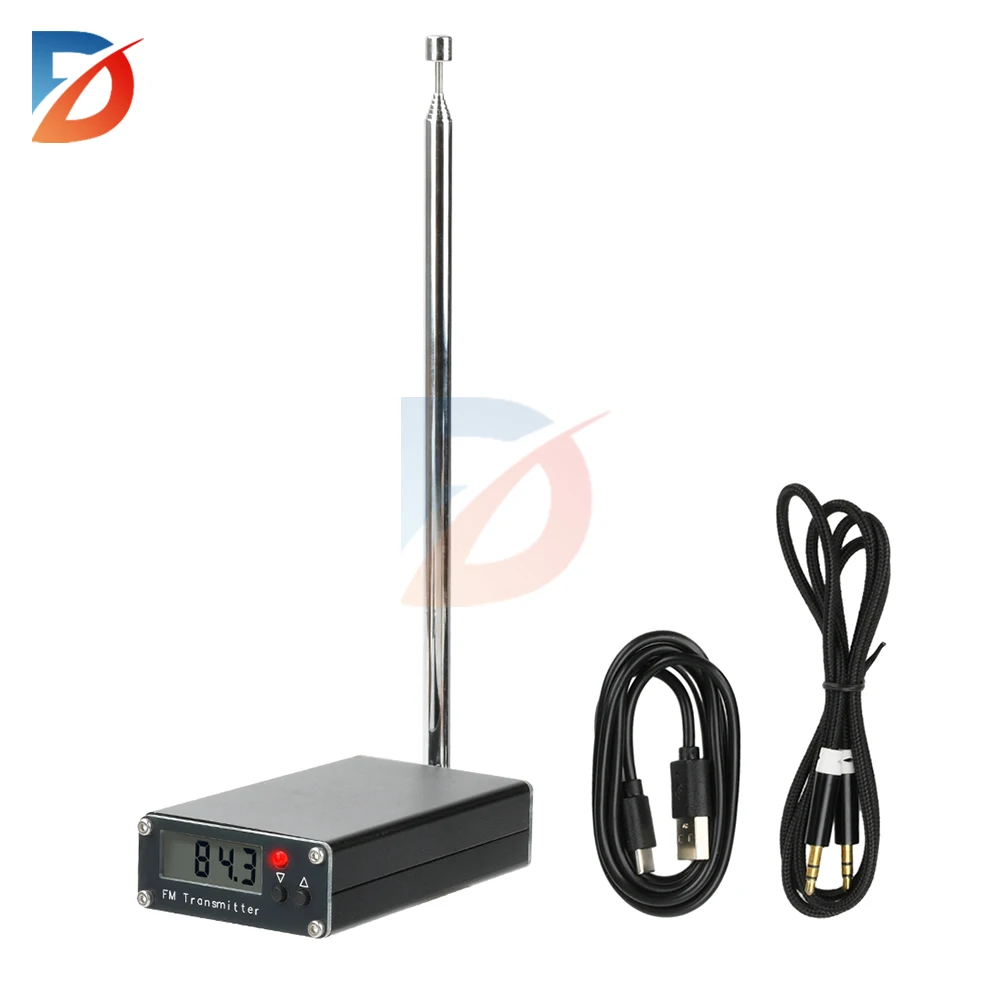
76-108MHz Frequency Band 2000m FM Transmitter 0.5W Digital LCD Display FM Transmitter Audio Stereo 3.5mm Interface USB Type-C 5V
You will be redirected to AliExpress to complete your purchase
Specifications
- Brand Name
- diymore
- Origin
- Mainland China
- High-concerned chemical
- None
- Condition
- New
- Type
- Module
- Quantity
- 1
- Package
- TQFP
- Choice
- yes
- semi_Choice
- yes
Product Description
1. Digital FM transmitter, supporting 76-108MHz frequency band, with 320 selectable frequencies.
2. Output power of 0.5W (500mW), with a measured transmission distance of up to 2 kilometers in open areas.
3. Equipped with LCD display screen, real-time display of current transmission frequency, intuitive operation.
4. Supports audio stereo input, with a signal-to-noise ratio of 63dB and clear and stable sound quality.
5. Compact and portable size 8.5x5x2cm, including accessories such as a telescopic antenna and power cord.
Parameter:
Interface: USB Type-C
Supply voltage: 5V
Power supply current: 500mA
Input signal: Audio stereo, 3.5mm interface standard
Signal to noise ratio: 63dB 0.05% THD
Size: 8.5x5x2cm (excluding protruding parts)
Output frequency: adjustable frequency, working range 76-108MHz, 1MHz or 0.1MHz step, a total of 320 transmission frequencies, with memory function.
Output power: 10~500mW (0.01~0.5W) @ 88-108MHz.
Receiving device: A regular radio that can receive FM broadcasts can receive the signal emitted by this transmitter well.
Display mode: LCD display, displaying the current transmission frequency. Please refer to the manual for details. Attached is the FM transmission antenna production data. It has been tested that this transmitter can reach a distance of 2000 meters in open areas.
Package Include:
1X host
1X rod antenna 1 meter
1X power cord
1X audio cable
Please note that:
1. This is a transmitter, a transmitter, not a radio, not a radio!
2. This transmitter cannot be directly plugged into a microphone as it does not support microphone input!
3. The transmitter does not have a battery inside and requires external power supply.
4. This is a transmitter and cannot be used to enhance radio signals. If you want to enhance the signal, please buy an outdoor antenna or antenna amplifier.
5. The transmitter socket buttons and other areas that require repeated force have been manually welded to prevent miraculous drops caused by excessive force.
Disclaimer:
When using wireless transmission devices, please comply with the relevant regulations of the local radio management committee and national laws. Anyone who modifies or increases the transmission power and usage range without authorization shall bear the consequences, and our store shall not be held responsible
You may be interested in learning more about this USB interface FM transmitter
Q: What's the use of this thing?
A: This is an FM transmitter. It can be seen as an FM small radio station, which inputs audio signals and outputs FM high-frequency signals, and transmits them into the air through an antenna. People in the distance are using radios to receive signals.
Q: Is this transmitter stereo?
A: Yes, this is a stereo transmitter.
Q: Is there a battery inside the transmitter?
A: The transmitter does not have a battery inside and requires external power supply. Logistics and express delivery companies may restrict the transportation of products with built-in batteries.
Q: What is the audio input interface of the transmitter?
A: The input should use a standard3.5mm audio interface, and the input volume should be appropriate. In the evaluation area, a friend's input is too large and clearly distorted. The volume should be reduced to achieve the quality of a typical FM radio station. Attention: This transmitter does not support microphone input!
Q: What is the transmitter antenna interface like?
A: The transmitter antenna interface is SMA specification, with external threads and internal holes. The corresponding antenna side requires the use of connectors with internal threads and pins.
Q: How is the transmitter powered?
A: The transmitter is powered by5V DC and the power interface is USB TypeC specification. The current consumption is approximately200mA. If a low-quality power supply is used, it may cause the transmitter to malfunction or the transmission quality to deteriorate, and the radio end will receive noticeable noise. The power supply voltage requirement is4.8-5.5V. Exceeding this range may cause abnormal operation or even damage to the transmitter. Please be aware!
Q: Can the transmitter use a microphone?
A: The transmitter cannot be directly plugged into the microphone. If a microphone amplifier is used, the amplified microphone signal can be input to the transmitter.
Q: Can a dummy load be connected to the antenna port of the transmitter to replace the antenna?
A: No, the dummy load is a pure resistor that will absorb the signal output by the transmitter, and the transmitter will have no energy to emit into the air. By connecting a false load to this transmitter and relying solely on the leaked weak power, the radio can receive the signal from this transmitter within one or two meters. Fake loads and antennas are two devices with opposite functions and cannot be used as substitutes.
Q: Can I directly connect a rod antenna to the transmitter?
A: Sure, but pay attention to one phenomenon: if you hear a beep or buzzing sound in the radio after using a telescopic antenna, it means that it has been interfered with. At this point, this phenomenon can be alleviated or avoided by reducing the transmission power. If this interference persists, then the transmitting antenna can only be kept away from the transmitter and front-end audio source. An antenna is a radiator, and when it emits high power, it can cause interference to surrounding electrical equipment. Therefore, if you find that your front-end cannot work under strong signals, you can only use a feeder to keep the antenna away from the transmitter and front-end, which can effectively avoid interference.
Q: Why can signals be received at +-0.1MHz near the receiving frequency point?
A: This is because the signal received by the radio is too strong. At this time, moving the radio away from the transmitter will eliminate this phenomenon.
Q: Why does my radio feel disturbed and its sensitivity decreases when receiving broadcasts on other frequencies while the transmitter is working?
A: The radio operates under strong transmission signals near the receiving frequency and will be suppressed. At this point, it is necessary to reduce the transmission power or keep the radio away from the transmitter to minimize the degree of suppression by the strong station. High end radios have a large number of filters at the front end to enhance their ability to resist suppression.
Q: How to set the transmission frequency?
A: The transmission frequency can be adjusted through two buttons on the panel, which can be selected in steps to change the frequency by1MHz or0.1MHz. Stop pressing the button for5 seconds, and the transmitter will automatically remember the current set frequency. The next time it is turned on, it will automatically transmit at this frequency without the need to set the frequency again.
Q: How to adjust the transmission power?
A: Enter the power setting mode by long pressing the up key, and set the transmission power by pressing the up and down keys. The transmission power can be set between10mW and500mW, with a total of11 power levels. Press the button to stop for3 seconds and automatically switch to frequency adjustment mode, saving the current transmission power. The next power on will automatically remember the previous transmission power and frequency.
Q: Can it really launch2000 meters?
A: The transmission distance is directly related to the transmission power, propagation conditions, and antenna performance. The nominal2000 meter transmission distance of the small shop is achieved under the conditions of a500mW transmission power, a full-size GP antenna installed on the14th floor, and no obstruction between transmission and reception. The antenna is strictly adjusted by the antenna analyzer, and the standing wave at the transmission frequency is1.2.
Product information last updated on January 6, 2026